
When a factory in Romania exports auto parts to Morocco, in what currency does it issue the invoice? When a refinery in Poland buys oil from Saudi Arabia, who decides whether payment is made in euros or dollars? And why does it matter to you, as a citizen or entrepreneur, that the price of oil is quoted in dollars, not in euros?
The currency in which international trade is invoiced crosses the boundaries of accounting and quickly becomes an indicator of economic power, vulnerability to currency fluctuations, and geopolitical influence. Today, on TheMacRO Zone, we take a look at the currencies in which the EU conducts its trade.
TRADE WITH COUNTRIES OUTSIDE THE EU
In other words, the European Union’s trade in goods with countries outside the Union reveals a division in the roles of currencies. In 2025, the euro was the main invoicing currency for EU exports, accounting for 51%, ahead of the U.S. dollar, at 33%. In contrast, for EU imports, the order is reversed: the US dollar was the primary invoicing currency, accounting for 51%, while the euro accounted for 40%. The remainder is split between the currencies of EU member states that do not use the euro and other currencies from outside the EU.
|
USE OF THE EURO WITHIN THE EURO AREA
Even within the eurozone, there is no such thing as a perfectly equal distribution. In 2025, Slovenia stands out as the country with the highest use of the euro for both imports and exports outside the EU. Its economy is closely integrated into European value chains, with trading partners that accept the euro as the reference currency.
- Non-EU imports in euros: 84%
- Exports outside the EU in euros: 91%
In terms of imports, the next highest rates of euro usage among countries are found in Austria and Croatia (63%), while for exports, the top rates are in Croatia (84%) and Malta (76%).
At the opposite end of the spectrum is Ireland, which, although a member of the eurozone, exports heavily in dollars due to the structure of its exports: pharmaceuticals, technology, and American multinationals with European headquarters in Dublin. When Apple or Pfizer export from Ireland to the U.S., they invoice in dollars, regardless of whether they pay VAT in euros in Dublin.
- Exports outside the EU in euros: only 13%
- Exports outside the EU in dollars: 75%
Cyprus has the highest share of the dollar in EU exports (76%) due to maritime trade and international re-exports, sectors where the dollar is the global standard currency.
In terms of imports, Denmark has the lowest share of the euro (23%), making heavy use of its own national currency (the Danish krone). Thus, low use of the euro does not always mean dollar dominance; in some countries, the national currency still plays an important commercial role.
ROMANIA: BETWEEN EUROPEAN INTEGRATION AND EXPOSURE TO THE DOLLAR
Romania is an interesting case because it does not use the euro as its national currency, but its economy is strongly integrated with the EU market.
ROMANIA, BY CURRENCY
2025 | %
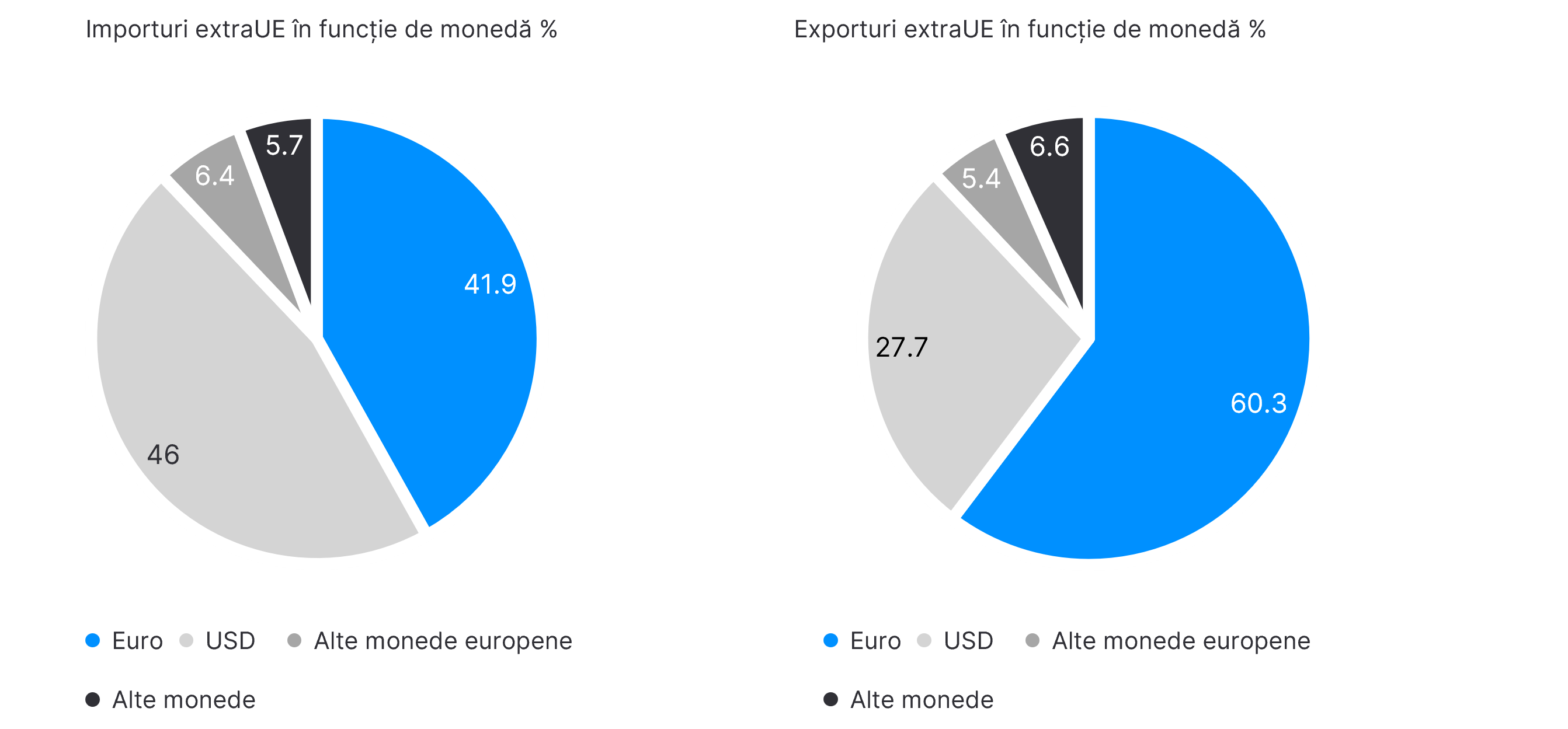
- Romania has significant trade exposure to the EU. Exports to the EU accounted for 71.4% of Romania’s total exports in 2025. This integration makes the euro a contractual, accounting, and financial benchmark for many Romanian companies.
- For Romania, the structure of extra-EU trade by invoicing currency places us between: European integration, reflected in the widespread use of the euro, and dependence on global markets, reflected in the significant role of the U.S. dollar.
- For non-EU imports, Romania invoices approximately 42% in euros, 46% in U.S. dollars, and 7% in other currencies. The fact that the dollar exceeds the euro in imports indicates thatRomania purchases goods from outside the EU that are frequently traded on global markets denominated in dollars. This situation is typical for imports of energy, oil, petroleum products, raw materials, industrial components, and goods sourced from international supply chains. The dollar serves here as a global reference currency, and Romania, even though it is strongly connected to the European economy, cannot avoid this dependence.
RISKS
When the dollar strengthens against the euro and the leu, Romania’s imports automatically become more expensive. Energy costs more. Raw materials cost more. Production costs rise. Inflation gets a boost. It all starts with an exchange rate that Romania has no control over.
- When it comes to exports outside the EU, the situation is more favorable: 60% are invoiced in euros, 28% in U.S. dollars, and 5% in other currencies. This structure is more advantageous for Romania from the perspective of European monetary integration. The fact that the euro is used in 60% of exports to non-EU countries shows that Romanian exporters prefer and are able to invoice in the European currency, even when selling outside the Union. The euro thus functions as a currency that provides contractual stability, reduces currency risk, and aligns with Romania’s main reference market.
OIL AND THE DOMINANCE OF THE U.S. DOLLAR
And to better understand why the dollar matters so much to the cost of living in Europe, let’s take a look together at how petroleum products are priced.
In non-EU imports of petroleum products, the U.S. dollar accounts for 86.7%, while the euro accounts for only 12.9%. This structure matters enormously for the EU and for Romania. Even if refineries, distribution companies, or end consumers operate in euros or lei, the price chain often starts with a global quote in dollars.
|
For non-EU exports of petroleum products, the dollar remains dominant, though to a lesser extent than for imports: 70.1% of petroleum product exports are invoiced in dollars, while the euro accounts for 27.5%. Thus, when the EU exports petroleum products, it can inject more euros into the market than when it imports oil or petroleum products, but it cannot break the dollar’s dominance in this market. We thus observe that Europe’s monetary power increases when it sells processed goods, but diminishes when it purchases raw materials.
BALANCE IN ADDED VALUE
Beyond oil, the picture becomes more balanced, and the euro can compete with the dollar even in trade inraw materials and commodities.
Raw materials (excluding oil):
- Imports: 47.4% in euros vs. 45.0% in dollars—nearly equal
- Exports: 62.2% in euros vs. 22.9% in dollars – the euro clearly dominates
Manufactured products:
- Imports: 46.2% in dollars vs. 43.3% in euros – a close race
- Exports: 50.4% in euros vs. 32.4% in dollars – the euro leads
For European companies, this means that the invoicing currency reflects their supplier structure, position in value chains, and bargaining power. Exporters to countries outside the EU naturally have an interest in invoicing in euros, especially when their costs, financing, and ecosystem are anchored in the eurozone.
In contrast, we have seen that importers of energy and raw materials remain exposed to the dollar, because these markets operate according to global rules.
In economic practice, the balance becomes clear: the more processed a product is and the more “European” its origin, the stronger the euro’s position. The closer we get to raw materials, traded globally, the more the dollar is the currency that dictates the rules of the game.
THE EFFECTS OF MONETARY POLICY | ||
|
| |
THE PATH TO RESILIENCE
The euro is a strong currency in international trade, but only when Europe is selling. When it comes to purchasing strategic resources, the dollar remains dominant.
This asymmetry can represent a structural vulnerability that any currency depreciation can trigger. We see it in our bills, in prices, and in inflation. As for Romania, we have seen that we are well integrated into Europe and export in euros, but when it comes to energy and raw materials, the currency switches to dollars. This makes us sensitive to currency movements that we do not control. The further we advance on our path toward the eurozone, the more we reduce this exposure, which, over time, translates into economic resilience.